top of page

Professional PRINT library
The source for each image is Amazon and is individually linked
 Hattie, J. A. C., Fisher, D., Frey, N., Gojak, L. M., Moore, S. D., & Mellman, W. (2017). Visible learning for mathematics: grades K-12: what works best to optimize student learning. Thousand Oaks (California): Corwin Mathematics. I am using this to facilitate a book study with my Math Department. It includes great strategies to use and when to use them to impact instruction. |  Almarode, J., Fisher, D., Assof, J., Moore, S. D., Hattie, J. A. C., & Frey, N. (2019). Teaching mathematics in the visible learning classroom: grades 6-8. Thousand Oaks: Corwin. A supplemental resource to the Visible Learning in Mathematics book, this one is geared towards the middle school classrooms and contains great ready-to-implement strategies. I recommend reading the first before jumping into this one. |  Kanold, T. D., & Larson, M. R. (2015). Beyond the common core: a handbook for mathematics in a Plc at work. Bloomington, IN: Solution Tree Press, a division of Soution Tree. While I have the books for Grades K-5 and Grades 6-8, this Leaders Guide is a great tool that captures it all. It captures the work that needs to be done before the unit, during, and after. I have often used this as I structure work with my teams. |
|---|---|---|
 Weber, C., Crane, D., & Hierck, T. (2015). Strategies for mathematics instruction and intervention, 6-8. Bloomington, IN: Solution Tree Press, a division of Solution Tree. This is another book I have used with my middle school math department, especially after piloting a curricular program. I especially appreciate Chapter 1 as it breaks down the prioritized standards, as well as the curriculum maps and the emphasis on pre-assessments. |  Miles, R. H., & Williams, L. A. (2016). The common core mathematics companion the standards decoded, grades 6-8: what they say, what they mean, how to teach them. Thousand Oaks, CA: Corwin. I wont lie – I have this for K-2, 3-5, 6-8 in print and on my Kindle so that I can reference it at any point! It breaks down each of the math common core standards and depicts what the teacher should be doing and what the student should be doing. It also lists common misconceptions that are often discovered. |  Small, M., & Tomlinson, C. A. (2017). Good questions: great ways to differentiate mathematics instruction in the standards-based classroom. Moorabbin, Victoria: Hawker Brownlow Education. When I saw Marian Small at a professional learning opportunity, I knew that I had to buy her book. I have leant this book out to so many people! It provides incredibly easy open-ended questions to differentiate math using a standard problem. |
 Ricci, M. C. (2017). Mindsets in the classroom: building a growth mindset learning community. Waco, TX: Prufrock Press. Having a growth mindset is critical to success and achievement, which is why it is important to build a growth mindset learning community. Having all learners take risks, make mistakes, and learn from them is critical. This book is a great reference tool on the importance of mindsets in the classroom and provides a few ways to help students adopt them. |  Newton, N. (2016). Math running records in action: a framework for assessing basic fact fluency in grades K-5. New York, NY: Routledge. I often use this resource with teachers in all grades, but mainly the elementary teachers who struggle with their students being fluent in addition, subtraction, multiplication, or division. The running records allow them to zoom in on exactly where the child is on the math development progression and provide them with a roadmap of what is ahead. | 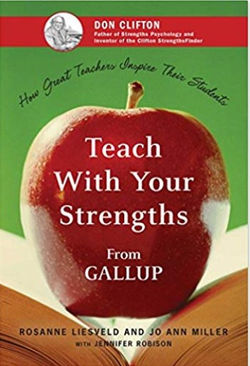 Liesveld, R. (2006). Teach with your strengths: how great teachers inspire their students. New York: Gallup Press. Knowing your strengths is powerful; using them is unstoppable. Knowing my strengths (discipline, achiever, responsibility, consistency, and includer), I often reference them throughout this book to see what it looks like and how I may be perceived by others. When I feel misunderstood or frustrated, I look to this book to see how I can change it. |
 Lemov, D., & Atkins, N. (2015). Teach like a champion 2.0: 62 techniques that put students on the path to college. San Francisco: Jossey-Bass. We received this book as a resource in one of the committees I am a part of, and it truly made me think. It made me miss being in the classroom and utilizing some of these techniques that are often forgotten with the hustle and bustle of every day life. It gives you access to 75 example videos of the techniques and how it can be easily incorporated. |  Hollie, S., & Allen, B. (2018). Culturally and Linguistically Responsive Teaching and Learning responsive teaching and learning; classroom practices for student success. Huntington Beach: Shell Education. Dr. Hollie joined our school district during one of our Institute days and left us all thinking about the students that we teach. This book takes us through what it means to be culturally responsive and the practices to implement in diverse classrooms. |  Houck, E. E. (2012). 100 Ways to Recognize and Reward Your School Staff. Alexandria, VA: ASCD. Teachers, secretaries, janitors, administrators – all stakeholders need to be recognized for their outstanding work. These elements of recognition includes praise, appreciation, opportunities, and respect. With over 100 easy-to-use opportunities organized by effort (low, moderate, more), this book contains just the start of ways that you can recognize and reward staff. |
 Garmston, R. J., & Wellman, B. M. (2016). The adaptive school: a sourcebook for developing collaborative groups. Lanham: Rowman & Littlefield. Being that I completed the Adaptive Schools Foundation Seminar, it is only fitting that I have this resource on hand. I often reference it and pull out excerpts of the text for teachers when focusing on the norms of collaboration and on different facilitation strategies and moves. It is a great resource to have if you lead groups (adults or students!)... |  Hirsh, S., & Crow, T. (2017). Becoming a learning team: a guide to a teacher-led cycle of continuous improvement. Ohio: Learning Forward. In my current role I meet with teachers on a weekly basis to lead them through a cycle of continuous improvement. It discusses the importance of collaboration and how the different stages of the learning cycle (analyzing data, setting goals, learning individually and collaboratively, implementing that new learning, and reflecting on it) can be sustained. |  Bloomberg, P., & Pitchford, B. (2017). Leading impact teams: building a culture of efficacy. Thousand Oaks, CA: CORWIN, a SAGE Publishing Company. This is one of the books I reference the most and always go back to. The amount of highlighting, post-its, notes, and tabs are astounding! It really gets down to the root of what is most important: building efficacy. Not only for teachers, not only for students, but collectively... |
 Brown Brené. (2018). Dare to lead: brave work, tough conversations, whole hearts. New York: Random House. I highly recommend this book for anyone considering to lead anything. Being a leader isn’t about the title, power, or status; it is being a model of who you hope others to be – ones that stay curious, ask the right questions, take risks, have empathy, take risks, and has courage. Brené Brown makes this a quick and easy read that truly captivates you and makes you think down to your core. |  Kotter, J. P. (2012). Leading change. Boston, MA: Harvard Business Review Press. While this book emphasizes more on business leadership, it can easily applied to educational leadership; after all, education is a business in which we are selling knowledge and experiences to those who may not realize they need it. It emphasizes an eight-stage process, with the fourth stage of “Communicating the Change Vision” standing out to me the most... |  Aguilar, E. (2016). The art of coaching teams: building resilient communities that transform schools. San Francisco, CA: Jossey-Bass. Being that my role is to coach teams, this resource lends itself perfectly. There is a wealth of downloadable tools and tasks that help to keep teams on track. |
 Brock, A., & Hundley, H. (2016). The growth mindset coach: a teachers month-by-month handbook for empowering students to achieve. Berkeley, CA: Ulysses Press. An easy to use month-by-month handbook for empowering students to have a growth mindset and achieve. It includes tools, lessons, reflection questions and resources aligned to the month’s focus. A great idea to incorporate in advisory, connections, or intervention courses. |  McGatha, M., Bay-Williams, J. M., Kobett, B. M. C., & Wray, J. A. (2018). Everything you need for mathematics coaching: tools, plans, and a process that works for any instructional leader: grades K-12. Thousand Oaks, CA: Corwin, a SAGE Publishing Company. The title says it all – it is everything you need for coaching. It includes surveys, reflection questions, protocols, tools for just about every aspect you can think of. I enjoy how each strategy connects to the Common Core Math Shifts... |  Hall, P. A., & Simeral, A. (2008). Building teachers capacity for success: a collaborative approach for coaches and school leaders. Alexandria, VA: Association for Supervision and Curriculum Development. I used this resource while going through an online professional development on leading out the implementation of our new math curriculum, Bridges. It is a great resource to have if you are a mathematics coach, but the “Continuum of Self-Reflection: Coach’s Model” found on pages 41-42... |
 Hansen, P.M. (2016). The mathematics coaching handbook: working with K-8 teachers to improve instruction. New York: Routledge, Taylor & Francis Group. Another resource I used while going through the Effective Coaching for Bridges Implementation professional learning. Pia Hansen is one of the contributors to Bridges by Math Learning Center as well as the author for this book. |  Wiliam, D., & Leahy Siobhán. (2016). Embedding formative assessment. Moorabbin, Victoria: Hawker Brownlow Education. Formative assessment should be a priority for teachers. I am not saying “short cycle assessments” or “exit slips” even. I am talking ways to formatively assess every 6-10 minutes or even every 6-10 seconds. Using this to gauge and drive your instruction is crucial. This book overviews 5 different formative assessment strategies, complete with the techniques and resources... |  Fennell, F. M., Kobett, B. M. C., & Wray, J. A. (2017). The formative 5: everyday assessment techniques for every math classroom. Thousand Oaks: Corwin. Instruction is an art. Mixing instruction with assessment creates a masterpiece that leads to incredible gains in student learning. While this book depicts 5 formative assessment strategies (interviews, observations, hinge questions, “show me”, and exit tasks), what I especially enjoy about it is the way it is laid out. Each strategy is defined |
Have any recommendations for me to check out? Would you like to collaborate on any of the readings? Share ideas? I would love to hear them all! Feel free to contact me as we build our repertoires of professional learning!
CLICK HERE FOR A PRINTABLE LIST
(also includes further annotations)
bottom of page